
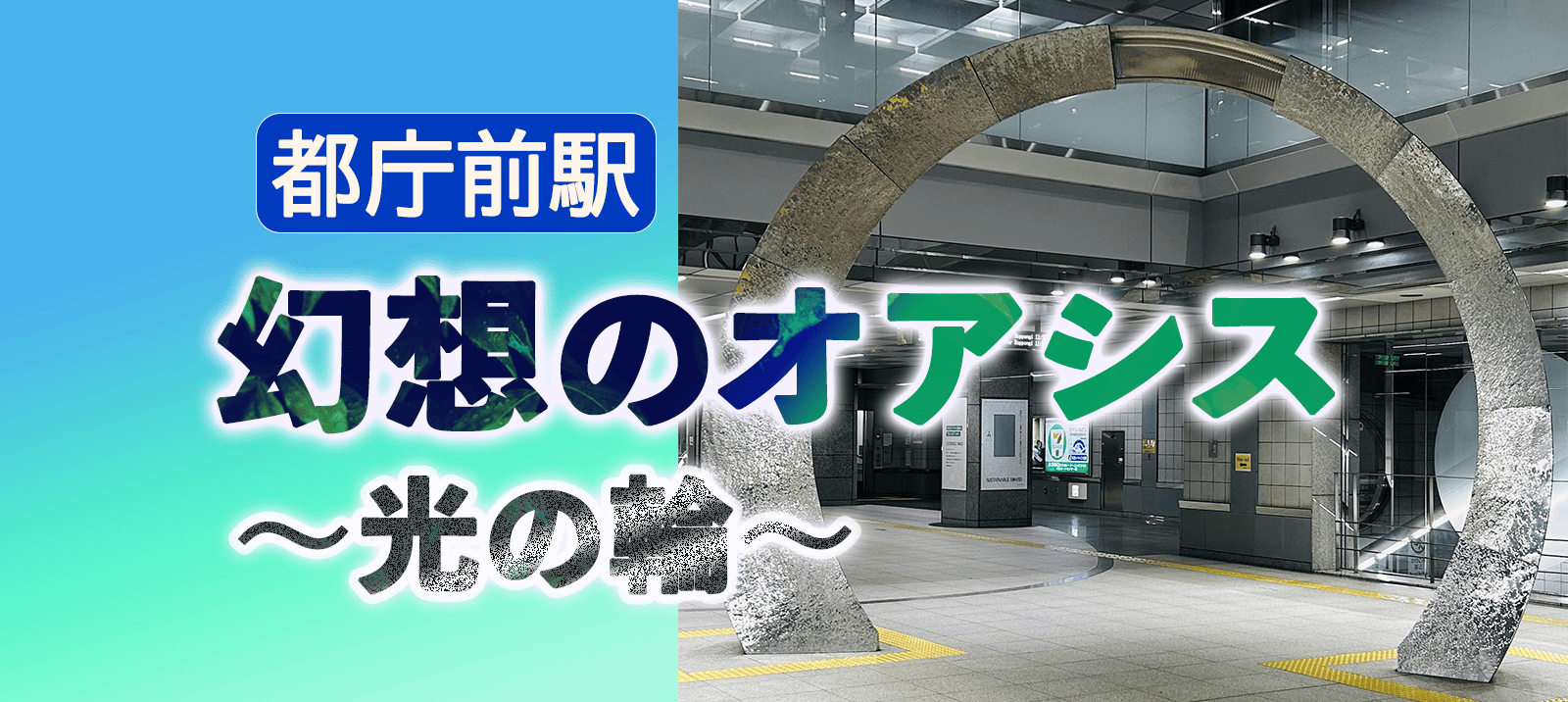
It’s a simple form, neither old nor groundbreaking, an art piece that seems to blend into everyday life. People who pass by here every day probably walk on without paying much attention to it.
And yet, the sparkling ring still reflected a sparkling light back into my heart, so I stopped and took a picture.
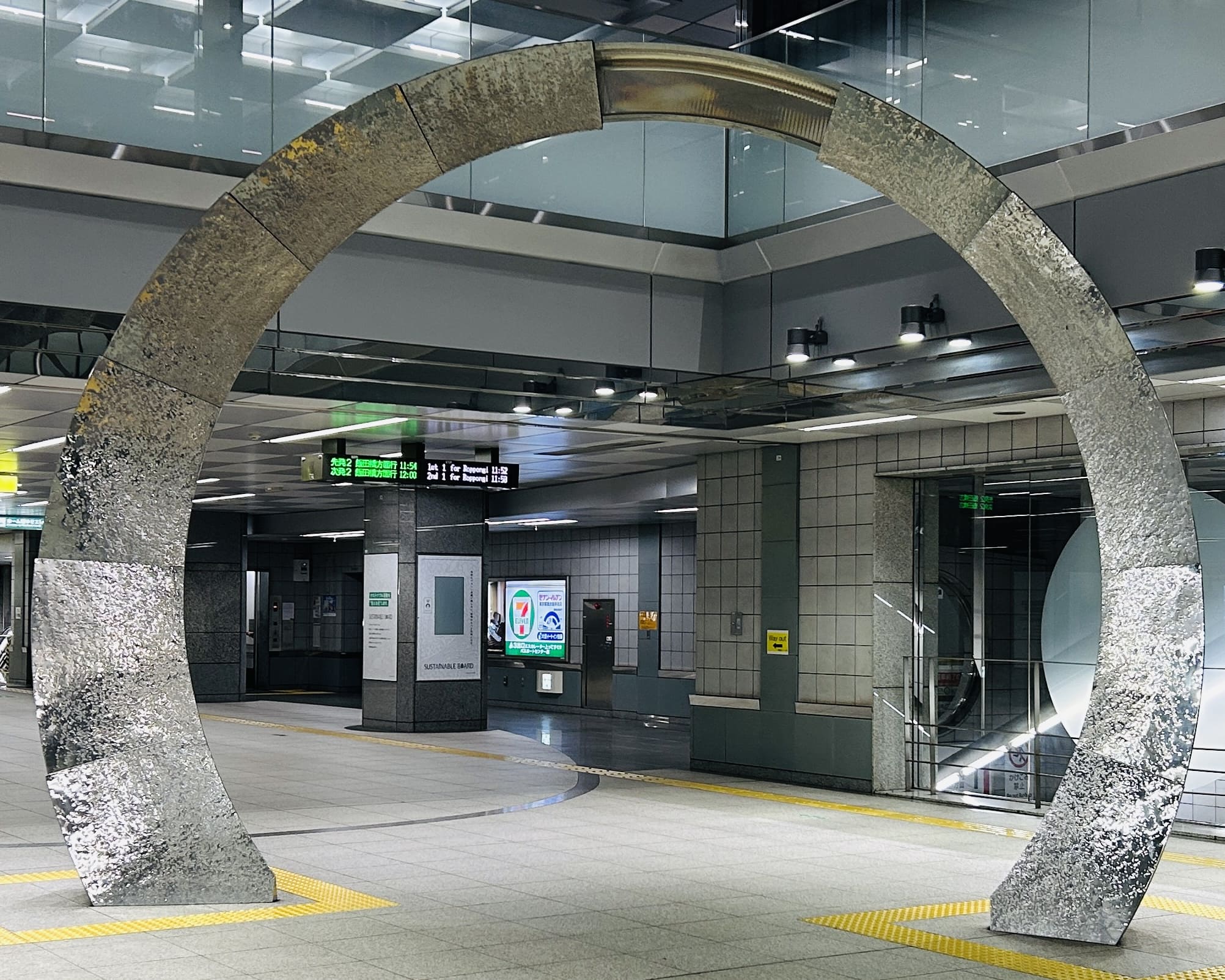
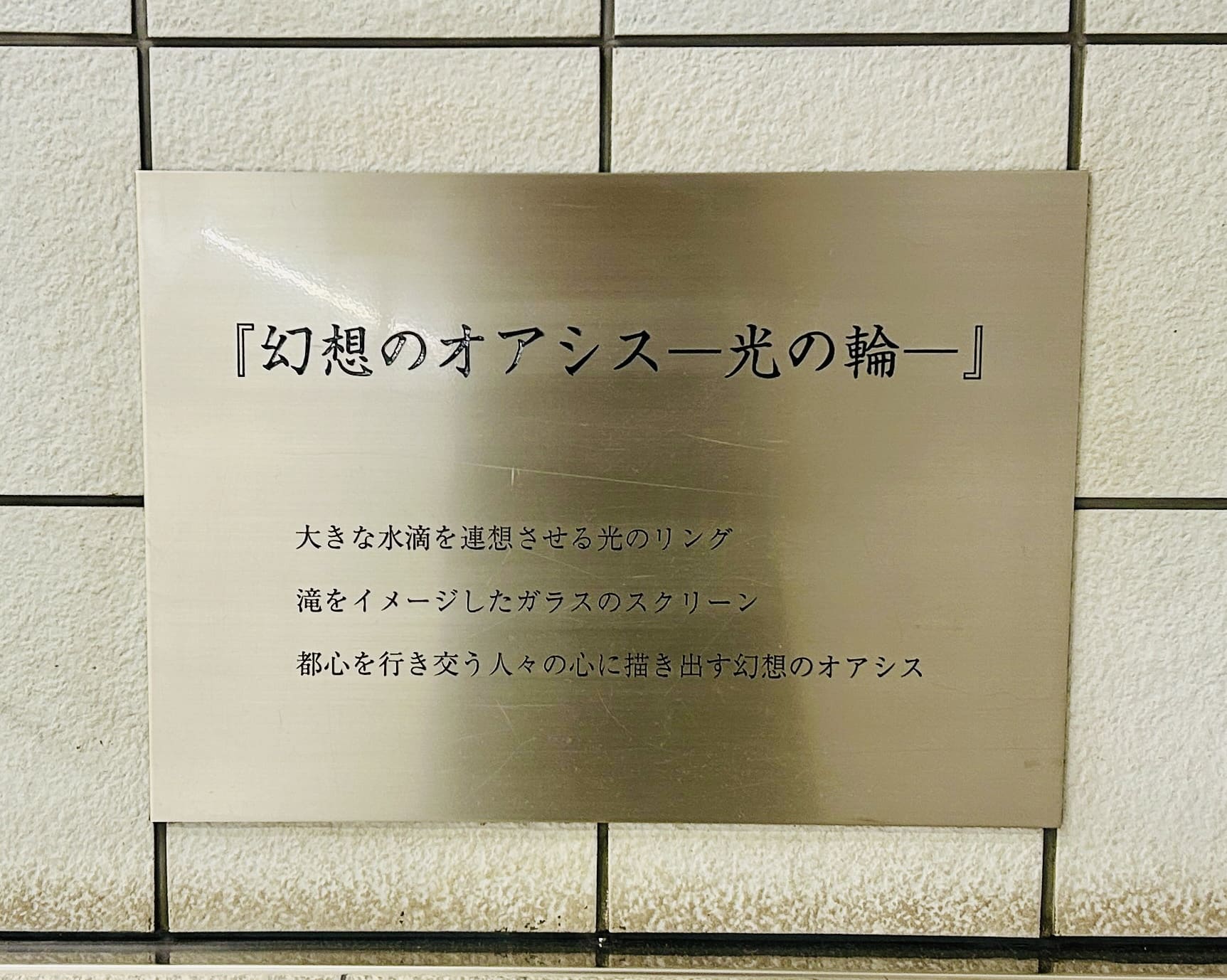
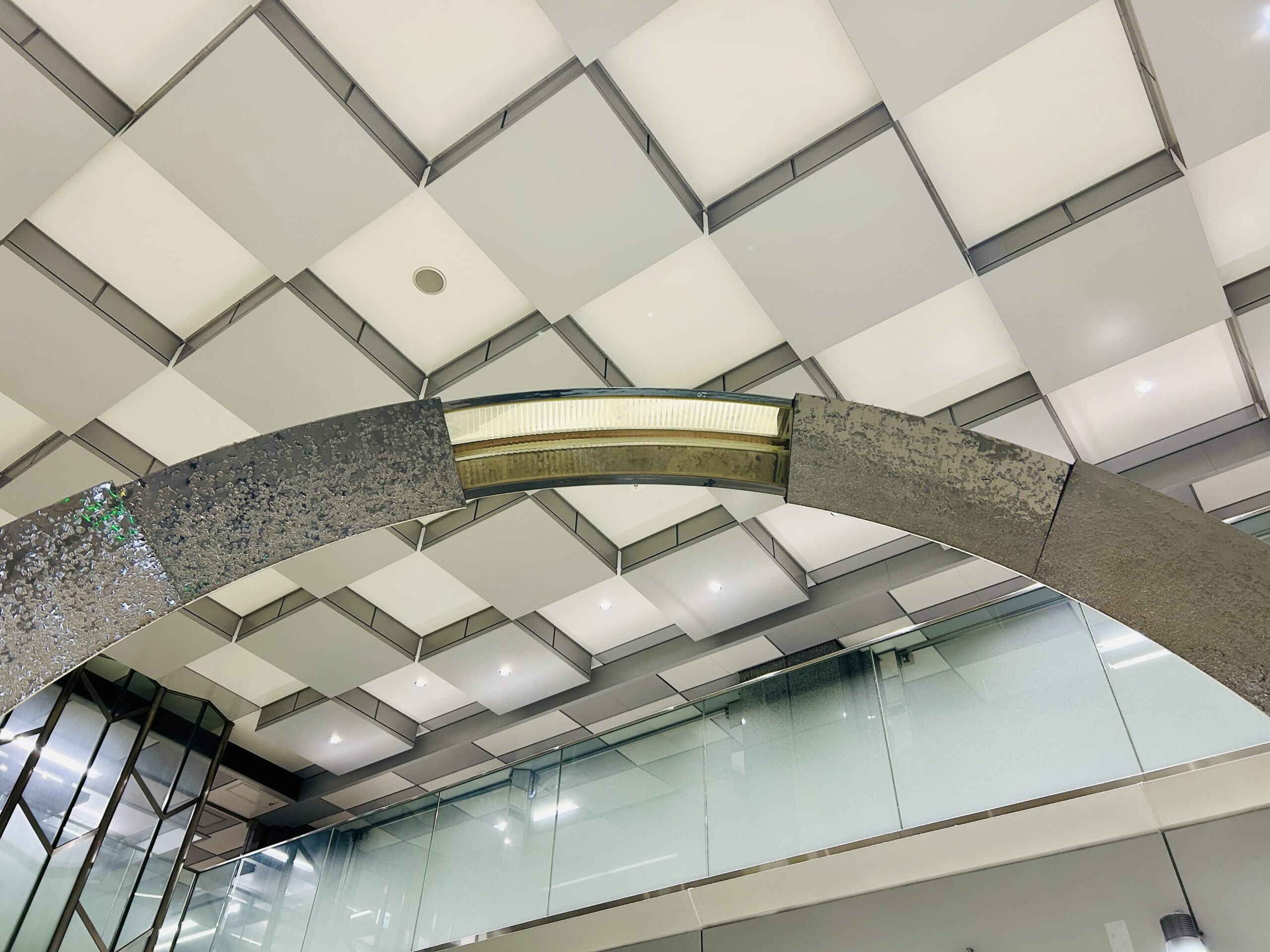
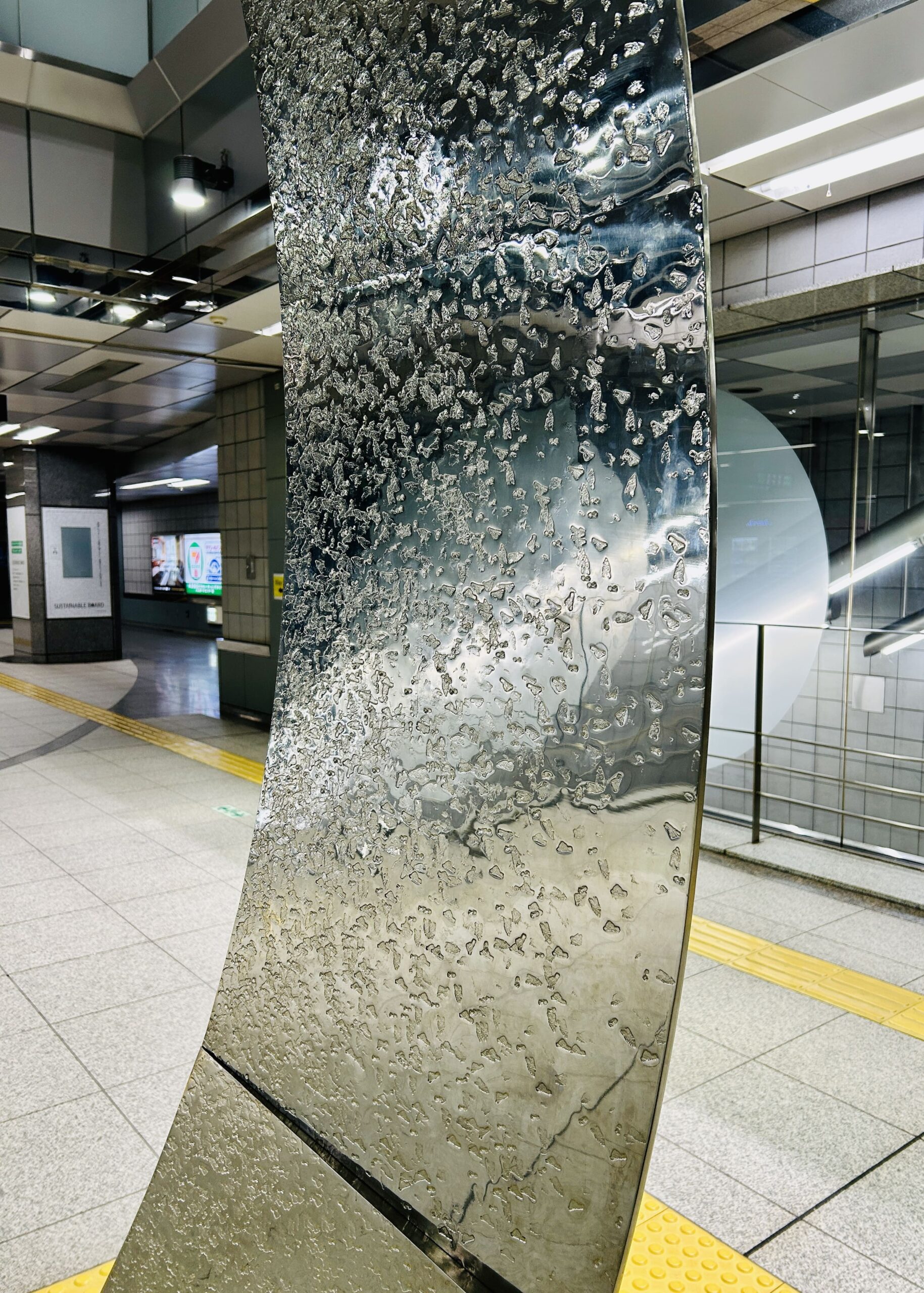
Oasis of Illusion – Ring of Light -“
From the artwork’s explanatory panel
A ring of light reminiscent of large water droplets, a
glass screen inspired by a waterfall, and
an oasis of fantasy painted in the minds of people passing through the city center.
“Oasis of Illusion –Ring of Light-“
Installation: Donated by the Japan Lottery Association in December 1997.
Artist: Unknown.
Location: Inside the ticket gate of Tochomae Station on the Oedo Line.
When we say “an oasis in the city,” the word oasis refers to a place that soothes, heals, or provides rest for people, but originally it referred to a fertile area in the desert with water sources and vegetation.
“An Oasis of Illusion”—I can’t help but think how refreshing it would be if there were a real waterfall underground, not just an illusion. Walking through Tokyo, which is plagued by scorching heat day after day, I find myself thinking that.
Descending the stairs leading to the subway, the temperature drops noticeably, and the sound of rushing water fills the air. Looking down, I see a waterfall cascading down from the ceiling of an underground plaza, wetting the rocks with spray. Subway users stand beside the waterfall, enjoying the coolness for a moment. —That’s the scene that comes to mind.
This artwork was installed in 1997. The title of the piece is “A Ring of Light Reminiscent of a Large Droplet,” but what was the “water situation” like at that time? I
suddenly wondered if the social conditions of the time were reflected in this artwork.
Upon investigation, it seems that while Tokyo in 1997 wasn’t experiencing a “severe water shortage,” concerns about water drought were becoming a real concern, and Tokyo’s water supply was undergoing a period of transformation, including changes in water volume, water quality, and earthquake countermeasures.
The following is an excerpt from a ChatGPT survey…
1. In early 1997, a winter drought actually occurred.In the Tone River system, water intake was restricted by up to 10% for 53 days, from February 1 to March 25, 1997.
In the previous year, 1996,
January 12 – March 27: Maximum 10%
August 16th to September 25th: Maximum 30%
They had experienced droughts in both summer and winter.
2. Tokyo was a massive city that used a huge amount of water.
In Tokyo around 1997, the maximum daily water supply hovered around 6 million cubic meters. A simple calculation shows this is equivalent to approximately 16,000 25-meter swimming pools.
Looking at households alone, the average daily consumption per person in fiscal year 1997 was approximately 248 liters.
(As of 2026, the average is 221 liters. According to data from the Ministry of Land, Infrastructure, Transport and Tourism, the nationwide trend in domestic water usage peaked around 1998 and has been on a gradual decline since then.)
3. The issue was not just the “quantity of water,” but also “safe and delicious water.”
In Tokyo at that time, dealing with substances that cause musty odors, such as ammonia nitrogen and organic matter, in some of the water sources was a challenge.
4. After the Great Hanshin-Awaji Earthquake, there was a strong awareness that water was a “life-saving resource.”
The 1995 Great Hanshin-Awaji Earthquake caused widespread water outages, making it difficult to secure drinking water and carry out firefighting.
Therefore, in Tokyo in 1997, not only was water scarcity a major issue, but also how to secure water in the event of a major earthquake.
5. The location where the artwork is situated is the birthplace of Tokyo’s water supply system.
The area around the Tokyo Metropolitan Government Building Station, where the artwork is located, was once home to the Yodobashi Water Treatment Plant.
The Yodobashi Water Treatment Plant began supplying water in 1898 as Tokyo’s first modern water treatment plant. After being decommissioned in 1965, its site was transformed into the Shinjuku sub-center, and in 1991, the Tokyo Metropolitan Government building relocated there.
The current high-rise building district of Nishi-Shinjuku is literally built on the site of a massive water treatment plant.
Indeed, the imagery of water in the artwork strangely resonates with memories of Tokyo at the time, when there was anxiety about water shortages, and of Nishi-Shinjuku, where the Yodobashi Water Treatment Plant once stood.
It is a public art piece that evokes a sense of reverence and prayer for the blessings of water.
As you investigate the background in this way, the sound of the “Waterfall of Illusion” begins to feel like the sound of a river that has been flowing continuously since the distant past. It is fascinating how artwork can enrich the imagination in this way.
These hot days can leave not only your body but also your mind parched, but to keep your heart from drying out, I want to live a rich and fulfilling life by engaging with art and history. I think it was thanks to that ring of light, that oasis of fantasy, that I was able to think that way.
It was a summer day when I felt grateful for water, for the water pipeline, and for that oasis of fantasy.
コメント